
He put the melting Arctic in the middle of the city.
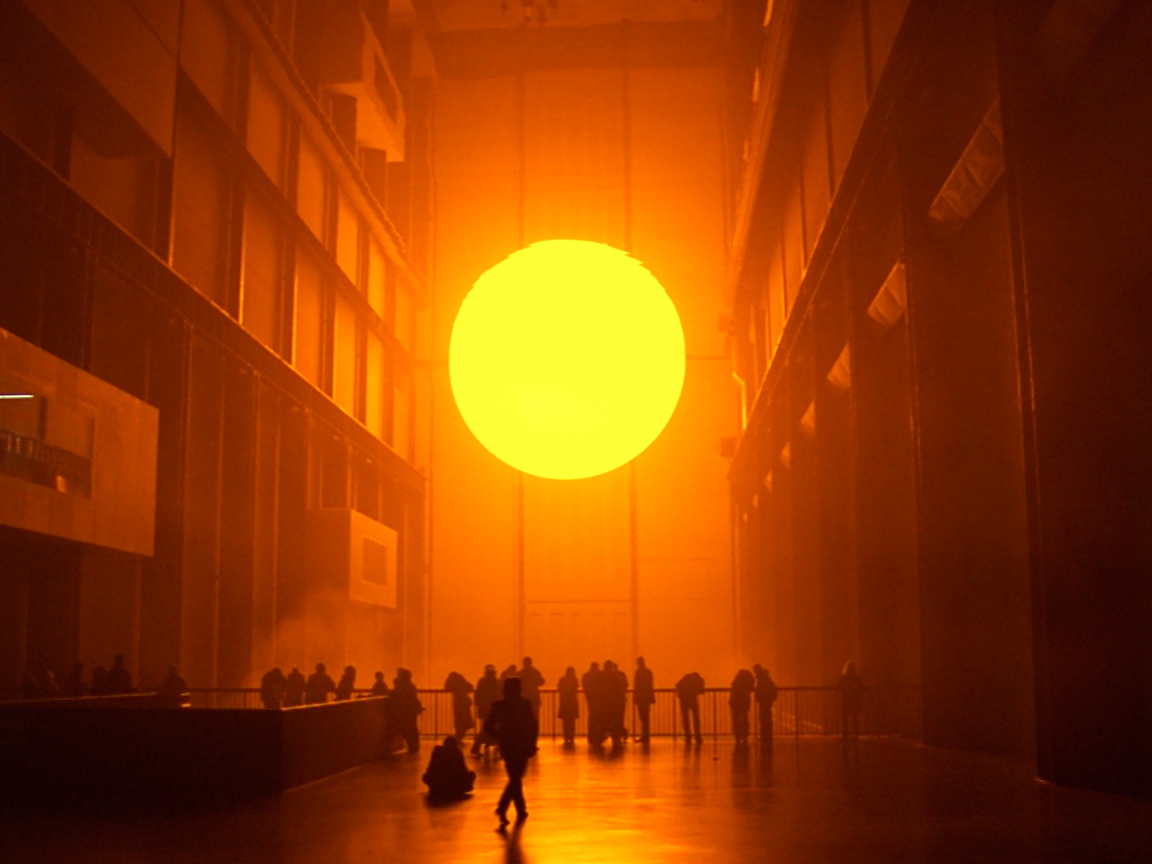
In 2003, Olafur Eliasson filled the enormous Turbine Hall of Tate Modern with a low orange sun made of lamps and fine mist, with a mirrored ceiling that doubled everyone below. Over two million people came, and they did something museums almost never produce. They lay down on the concrete floor, in public, together, and looked up. Strangers made shapes with their bodies in the mirror. A building became a weather system, and a crowd became a community without being asked.
Eliasson works at the seam between science and feeling. His studio in Berlin runs like a small research institute, full of engineers, geometers, cooks and archivists, testing how colour, water, fog and reflection change what a body senses. He is not interested in showing you a beautiful object. He is interested in making you notice that you are a person in a space, with other people, right now.
That intent turned political with Ice Watch. Eliasson and a geologist harvested blocks of glacial ice already broken off the Greenland ice sheet, ice that was going to melt in the ocean regardless, and installed them in the public squares of Copenhagen, Paris and London, arranged like a clock. People touched ten thousand year old ice. Children pressed their faces to it. Over days, in front of everyone, the future melted into puddles and evaporated off the stone.
No lecture could do what the ice did. Eliasson understood that data does not move people and presence does. He took an abstraction, a warming planet, and made it something you could put your hand on until it was gone.
His work is a lesson in the difference between telling and staging. A statistic asks to be believed. An experience does not need permission. It simply happens to you, and then you cannot unfeel it. The most creative act available to any of us is often not a new argument. It is a new way of arranging the world so the argument becomes unnecessary.
What truth are you trying to explain that you could instead let someone touch?