
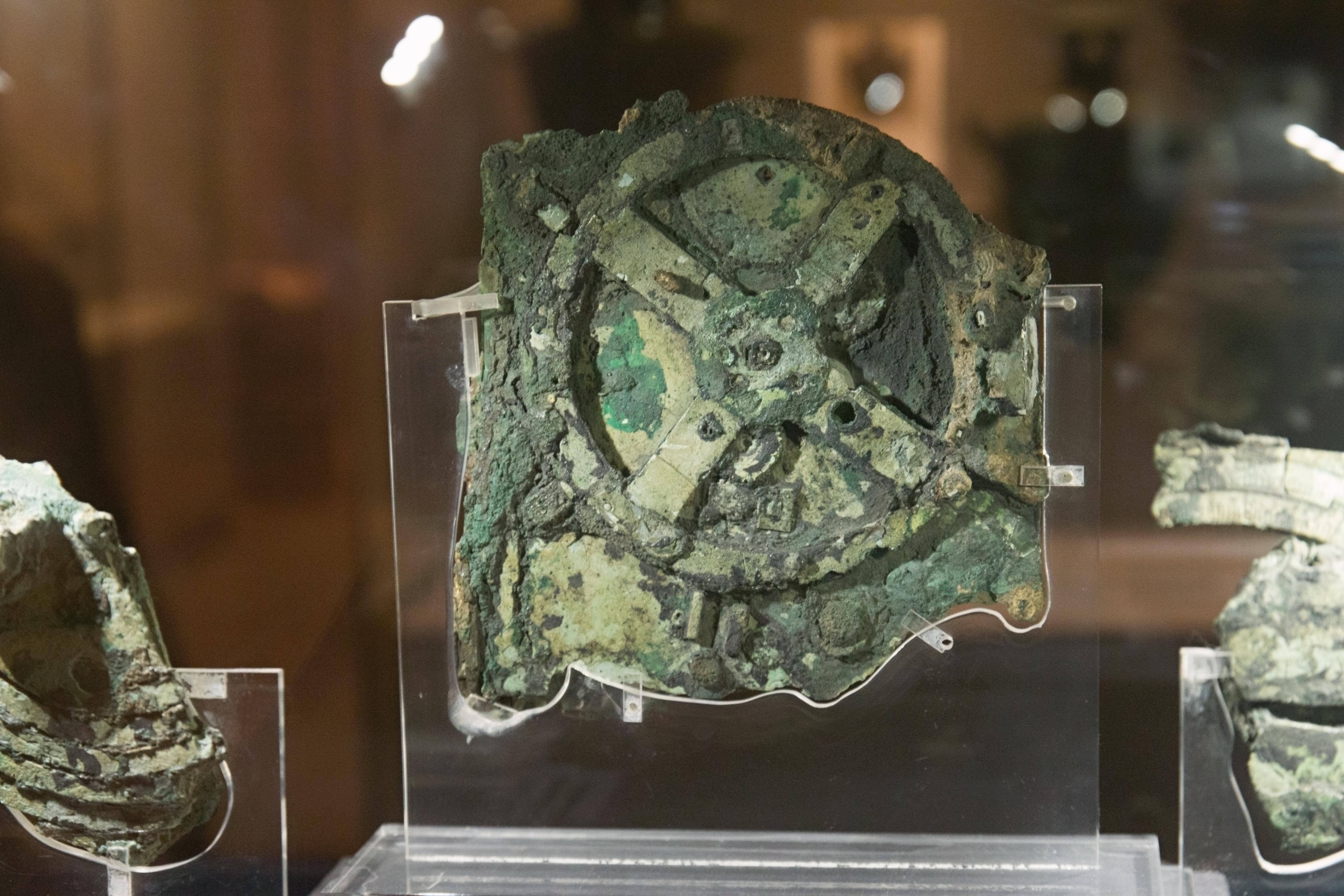
A 2,000-year-old computer from the sea.
In 1901, sponge divers working a shipwreck off the Greek island of Antikythera brought up statues, coins, and an unremarkable lump of corroded bronze that sat ignored in a museum while everyone admired the sculptures. When it eventually cracked open, it revealed something that should not have existed. Gears. Dozens of finely cut, interlocking bronze gears, packed into a device the size of a shoebox, more than two thousand years old.
It took a century of study, and eventually X-ray and CT scanning that could see through the corrosion, to understand what it was. The Antikythera mechanism is an analog computer, a hand-cranked machine of at least thirty gears that modelled the movements of the heavens. Turn the handle and it showed the position of the sun and moon, the phase of the moon, the timing of eclipses years in advance, the cycles that governed the ancient calendar and even the schedule of the Olympic games.
The staggering part is not just that it exists but that it is alone. Nothing else of remotely comparable mechanical sophistication survives from the ancient world, and nothing like it would appear again for well over a thousand years, until the astronomical clocks of medieval Europe. It is a technology that flowered, apparently, and then vanished, its knowledge lost, so that for a millennium and more humanity had built nothing so intricate.
It forces a humbling rethink of the ancient world. These were not primitive people fumbling toward the future. Someone, somewhere, understood gearing and astronomy well enough to compute the cosmos by hand, and then that knowledge slipped away, a reminder that progress is not a straight line and that things once known can be forgotten completely.
The lesson is about how fragile knowledge is. A capability that took genius to create can disappear if it is not shared, taught and passed on, leaving only a single corroded survivor to hint at what was lost. What you know how to do is not safe simply because it exists. It is safe only if you spread it.
What do you know that would be lost if you did not deliberately teach it to someone else?


